

Our understanding of anatomy has moved beyond the idea that our skeleton alone provides the stability that lets us stand, walk, run, and even lie down without collapsing into a pile of bones. We once imagined bones as rigid, pillar-like structures stacked for support. In recent years, however, a concept from architecture and sculpture has offered a more accurate way to describe how our bodies are organized. It’s called tensegrity—specifically, biotensegrity when we apply it to living bodies.
Biotensegrity is a framework for understanding how bodies stay stable and respond to loads by balancing tension and compression. One key component of this tension-and-compression model is fascia. Fascia is a fabric made mostly of collagen and elastin fibers. For years, it was thought of as an unimportant, passive wrapping around muscles and organs. We now know it works as a responsive, continuous, integrated web throughout the body—wrapping, supporting, and linking cells, nerves, organs, muscles, muscle bundles, and bones. In other words, fascia is a tension framework that helps hold the body together at every level.
When fascia is healthy, tissues can glide smoothly against one another, allowing movement with flexibility and ease. That is, in a very direct way, how we move.
Our habitual movements continuously “tune” this framework. When a body part isn’t moving, fascia tends to tighten and knit around it to provide stability—almost like a cast on a broken, immovable arm. When we move again, the fascia restructures and releases that grip. Repeated movement patterns—how you stand, lift, run, sit, reach, and breathe—continually reorganize how tension is distributed through the system. That process shapes both body structure and the felt experience of movement.
It also means that when something in one area goes off balance, the interconnected system can reorganize elsewhere to varying degrees. An injury in the foot, for example, can show up as pain or soreness in the neck.
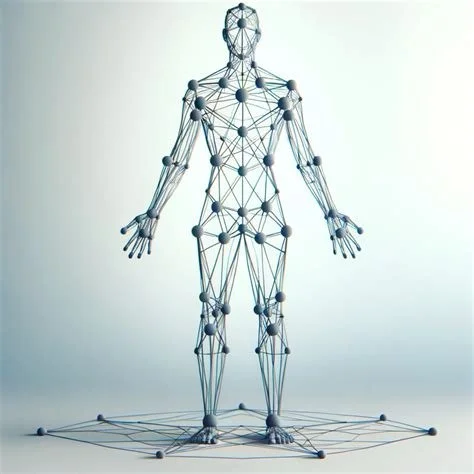
I’d like to propose that there’s value in applying this understanding of fascia to our approach to psychological health and balance—recognizing that psychological wellbeing is never separate from emotional, physical, and spiritual wellness. Just as fascia is a joining factor, we can imagine mind, body, and spirit as being surrounded, interpenetrated, and joined by an unnamed force—so that when a stimulus affects one area, all areas respond. There is no separation.
Emotional and psychological disturbances don’t stay “in the head.” They can show up in how we move, how we sit and stand, in tension patterns, physical symptoms, illness, and even in how we relate to what we cannot know with our senses. Likewise, spiritual blockages and imbalances can appear as an inability to see beyond a narrow focus of threat, or as limitations in imagination, creativity, and the capacity to experience awe.
Just as the body molds itself to the movements of the person, the psyche can “harden” into personality structures shaped by experience. When experience supports wellbeing, we become flexible and resilient. When basic needs aren’t met with kindness and connection—or when trauma occurs—we develop ways of seeing, thinking, and believing that lock onto the wounds and limit creativity and authenticity.
By the time we learn to walk and talk, we’ve already formed expectations, reactions, and strategies based on early experiences. Similar to the way fascia adapts through repeated movement patterns, we shape fixed patterns of thinking and acting in response to early imprints—and we’re often not aware of them. These imprints become the stories we live by: who we are, how safe we feel, how others are likely to treat us, and what the world demands of us.
This hardening is a normal part of human development. It’s how we learn to survive and adapt. But as adults, protective or adaptive mechanisms may no longer serve us. Like . broken arms that need to move again when the cast comes off, our automatic rigid patterns need to become flexible and responsive again.

Fortunately, just as fascia can be re-educated, dysfunctional patterns can be rewired with appropriate interventions. Old narratives can loosen. Many people do this through psychotherapy, which often involves identifying and untangling old habits, compulsions, and beliefs through insight and—sometimes—energetic or somatic approaches.
If we take the “whole system” idea seriously—that what affects one part affects the whole—the implications for healing are enormous. Psychological trauma, emotional repression, and habitual behaviors can create disruptions in physical health. We may lose the capacity for flexible perception—our ability to hold paradox and mystery.
So when we want behavioral change in patterns of thought and belief, we may also need to pay attention to the body’s patterns—especially how stress and unresolved experiences are held in our physicality. It may help to combine approaches: psychotherapy to unravel memories and psychological imprints, alongside bodywork that helps the physical system shift in parallel. We can also explore the two-way nature of these connections—how emotional and “psychic” events may have contributed to physical issues, and how physical patterns may, in turn, have shaped emotional life.
We can generalize a guiding principle for growth this way: when things shift out of balance, they often move back toward equilibrium—especially if the imbalance is brief. But if the distortion continues for long periods, it can create psychological, physical, and spiritual blockage that takes real effort to correct.
The good news is that there are many ways to support this kind of change, and many helpful people and practices you can turn to. Best of all, you get to choose what feels right for you in any given season of life—because what helps at one level can help across the whole integrated system.