
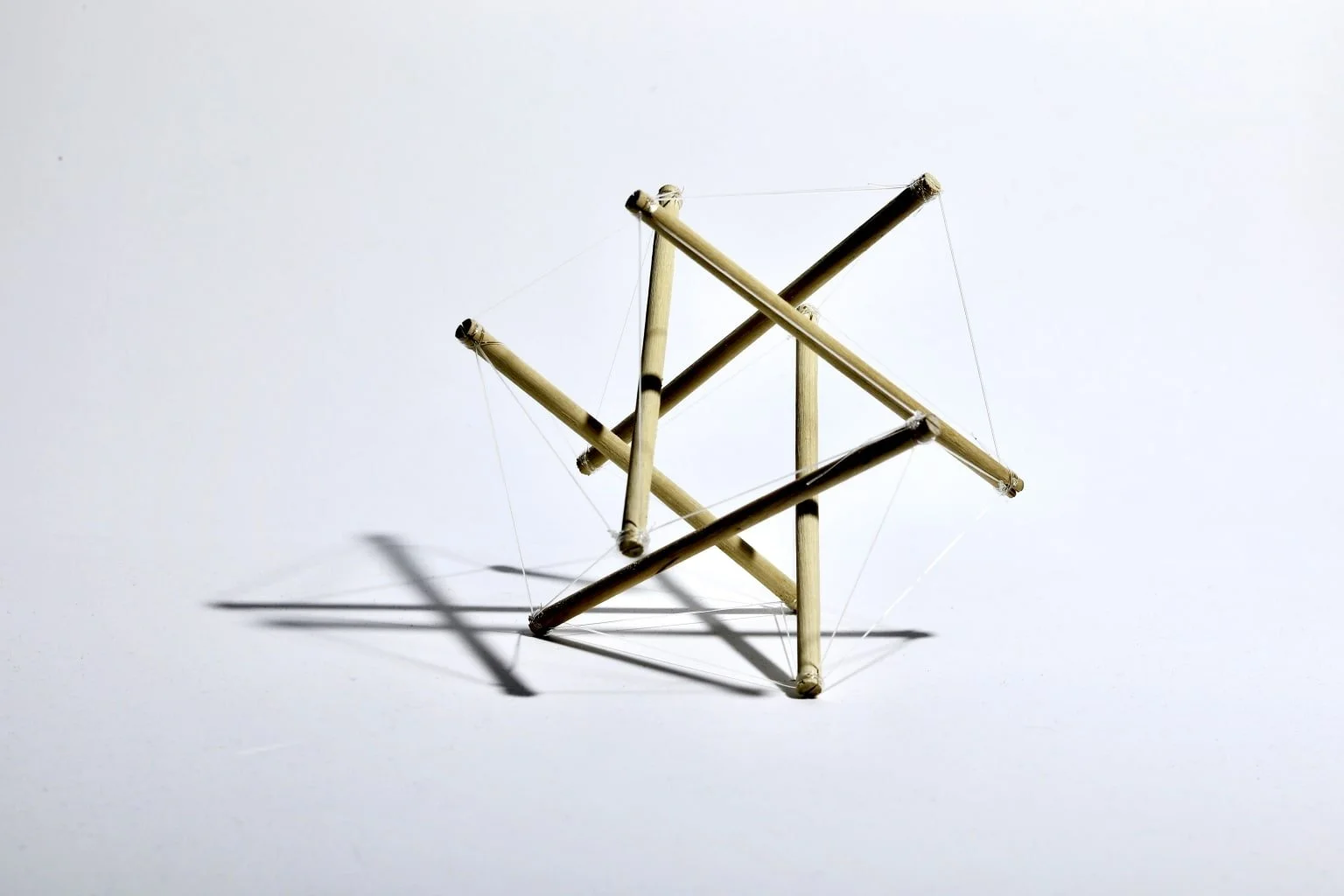
In 2019 I was offering bodywork to clients to help relieve mobility issues and pain, based on the principle of biotensegrity. I’m not offering that work now, but I’ve continued thinking about tensegrity—and about how its logic might apply to humans beyond the body.
Below is a recap of the original post, followed by additional thoughts for how this framework can extend to the mind and inner life.
Tensegrity and Biotensegrity (recap)
Tensegrity is a concept that combines tension and compression. It’s sometimes described as tensional integrity or “floating compression.” In tensegrity structures, components are held in place so that the structure appears solid, but the parts are not directly touching. The stability comes from the way forces are distributed through the system.
In the human body this relationship between compression and tension, called biotensegrity, is what gives the body its shape and helps it maintain its structure. Your bones don’t stack on top of each other for support. Instead, they “float” in a network of connective tissue called fascia. The body can be seen as one organized whole, connected by this network made of collagen and elastin fibers that connects, interpenetrates, and surrounds all parts of the body, including cells, organs, muscles, and bones.
The structure of a well-aligned and flexible body can become distorted by acute injury or by chronic, habitual tension—whether from prolonged sitting, repetitive sports, playing a musical instrument, or even unconscious facial habits like furrowing your brow. Fascia then molds itself to “lock in” those patterns over time. In other words, the body shapes itself to what we do with it.
Since everything is connected by this fascial network, changing one part of the system affects the whole. Imagine wearing a tight body suit. When you tug on one sleeve, all the threads in that sleeve pull on adjacent threads and distort the shape of the rest of the suit. That’s one reason injuries often seem to “spread.” For example, if you sprain an ankle, you may change how you walk to protect it and your knee mis-aligns, causing your hip to become unstable. Over time, the fascia will to some degree knit itself into a protective pattern. The longer the immobility lasts, the more established that pattern becomes. Even after recovery, those shape changes persist.
Stretching alone is rarely enough to repair these distortions. They need to be “reprogrammed” so the fascia can become flexible again and allow a return to the healthier alignment. In my experience, approaches such as Vibrational Fascia Release Technique (using tuning-fork vibration) and the MELT method (using soft tools to encourage fluid flow through connective tissue) reduce the pain, stiffness, and tension of these dysfunctional adaptations and promote their return to normal.
Extending the principle: psycho-spiritual tensegrity
I’d like to extend this idea into what we might call psycho-spiritual tensegrity. The core thought is simple: mind, body, and spirit are interconnected by an unnamed force, so that even when a stimulus is applied to one area, all of them are affected. And when we repeatedly disrupt the system’s balance, that disruption becomes our new normal—until we undo it.
What we carry emotionally and psychologically doesn’t stay “in the head.” It shows up in posture, tension patterns, and physical symptoms. Even spiritual blockages tend to appear as limitations in imagination, creativity, and physicality.
Continuing the metaphor, the psyche “hardens” into a personality that has been shaped by our experiences. When experience supports wellbeing, we are flexible and resilient. When our basic needs aren’t met with kindness and connection, or when we are subjected to trauma, we develop ways of seeing, thinking and believing that lock onto those wounds of omission and limit our creativity and authenticity.
It starts early. By the time we learn to walk and talk, we’ve already formed expectations, reactions, and strategies based on our experiences. Just like fascia shapes itself based on movement patterns—we also develop fixed patterns of thinking and acting in response to those early imprints. And we’re mostly not aware of them.
This can imprint the stories we live by, about who we are, how safe we are, how others are likely to treat us, and what the world demands of us. It’s also worth noting that this hardening is a normal part of human development—it’s how we learn to survive and adapt. But as adults those protective or adaptive mechanisms don’t serve us anymore, instead causing automatic patterns of defensive behavior that kick in before we even realize it.
Fortunately, with appropriate interventions, even dysfunctional patterns can be rewired. Old narratives can loosen. Many people do this through psychotherapy, which often focuses on identifying and untangling old habits, compulsions, and beliefs.
If we take the system idea seriously—that what affects one part affects the whole—the implications for healing are enormous. Reprogramming may involve not only behavior, thought, and belief, but also the body’s patterns and the way we hold stress and unresolved experiences over time, including illness or chronic pain.
It may help to combine approaches—doing therapy to unravel memories and psychological imprints, while also using bodywork that helps the physical system shift in parallel. We might also explore the two-way nature of these connections: how emotional and “psychic” events may have contributed to physical issues, and how physical patterns may, in turn, have shaped emotional life. This exploration could happen through psychotherapy, or through experiences that support emotional release and expression—whether you take part as an observer, a participant, or a creator.
Underlying all of this is the idea that we each have a real, underlying self, that existed prior to imprints of all kinds. As you unwind imprints, you don’t lose that solid sense of self. You will still have preferences and tendencies, but the compulsion to experience everything through one fixed lens based on the past begins to loosen.
We can generalize the principle like this: when things shift out of balance, they tend to move back toward equilibrium—especially if the imbalance is short in duration. But if the distortion goes on for long, it causes psychological, physical and spiritual blockage that require effort to correct.
The good news is that there are many ways to support change, and many helpful people and practices you can turn to. And best of all, you get to choose what feels right for you in any given season of life—because what helps at one level helps across the whole integrated system.